

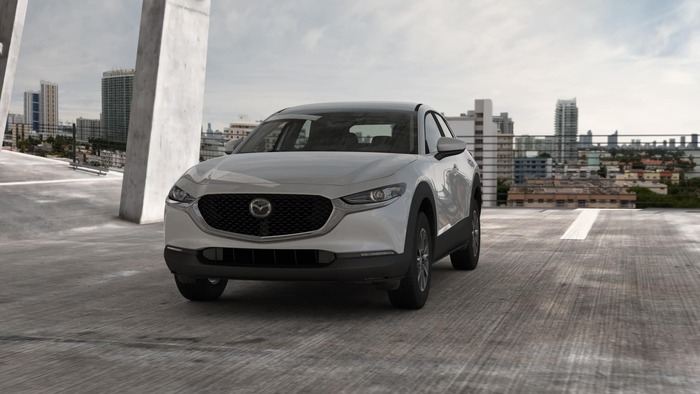
Trying to decide between the 2025 Mazda CX-30 and the 2025 Honda HR-V? You’re not alone. These two popular subcompact SUVs offer great value, but which one truly fits your lifestyle, driving needs, and budget? The Mazda CX-30, launched in 2019 as a 2020 model, offers an upscale feel and sporty driving dynamics, neatly fitting between the CX-3 and CX-5 in Mazda’s lineup. Meanwhile, the Honda HR-V, redesigned for its second generation in 2023, prioritizes practicality and fuel efficiency, being built on the reliable Honda Civic platform. In this detailed comparison guide, we’ll break down performance, design, comfort, and tech so you can choose the right SUV for your driveway.
New Updates for 2025
The 2025 Mazda CX-30 introduces several enhancements, including a new native navigation system that offers greater detail, live traffic updates, and over-the-air updates. Voice control with Alexa lets you manage more features hands-free. Mazda now offers the CX-30 in a stylish new Aero Gray exterior.
Except for a slight increase in the MSRP, the 2025 Honda HR-V carries over unchanged from the previous year.
Performance and Powertrain
The Mazda CX-30’s performance stands out with its robust powertrain options. The base engine is a 2.5-liter Skyactiv-G four-cylinder that delivers 191 horsepower and 186 pound-feet of torque. For those craving more power, an optional turbocharged 2.5-liter four-cylinder offers 250 horsepower and 320 pound-feet of torque (with premium fuel). With a six-speed automatic transmission and available all-wheel drive, the CX-30’s turbo variant zips from 0 to 60 mph in just 6.4 seconds.
In contrast, the Honda HR-V comes with a 2.0-liter four-cylinder engine that outputs 158 horsepower and 138 pound-feet of torque, alongside a continuously variable transmission. While it also offers all-wheel drive, it’s noticeably slower, with a 10-second 0-to-60 sprint time. The Mazda clearly offers a sportier feel and quicker acceleration, making it the performer of the two.
Safety Features
Safety is a priority for both manufacturers, with the 2025 models offering comprehensive suites of safety features. The Mazda CX-30 is an IIHS Top Safety Pick+ and has an NHTSA five-star overall safety rating. It comes standard with features such as automatic emergency braking, lane departure warning, lane-keep assist, and adaptive cruise control, with options for a 360-degree camera system and traffic jam assist.
The Honda HR-V is an IIHS Top Safety Pick and also boasts an NHTSA five-star overall safety rating. Standard features include the Honda Sensing suite, which include the Collision Mitigation Braking System, Road Departure Mitigation System, adaptive cruise control, and lane-keep assist. Blind-spot monitoring and rear cross-traffic alerts are available as additional features. However, Mazda’s 360-degree camera system gives it a slight edge in safety technology.
Mazda vs Honda: Interior and Comfort
The Mazda CX-30’s interior features upscale materials, underscoring its premium feel. Leather seating is available for added luxury. Cargo space measures 20.2 cubic feet with all seats up and 45.2 cubic feet with the seats down, while passenger volume is 94.1 cubic feet.
The Honda HR-V focuses on simplicity and functionality. Cloth seating is standard, with leather available on top trims. It provides more cargo space — 24.4 cubic feet with the rear seats up and 55.1 cubic feet when down, alongside a larger passenger volume of 98.7 cubic feet. While Mazda offers a more upscale experience, Honda excels in space and practicality.
Exterior and Design
The Mazda CX-30 features a sleek, sporty design with standard LED headlights and a choice of 16-inch to 18-inch wheels. At 173.0 inches in length, 70.7 inches in width, and 61.7 inches in height, the Mazda CX-30’s wheelbase measures 104.5 inches.
The Honda HR-V, with its more traditional SUV design, has a slightly larger footprint, reaching 179.8 inches in length, 72.4 inches in width, and 63.4 inches in height, maintaining the same wheelbase as the CX-30. While the Mazda is visually more dynamic, the Honda is bulkier.
Mazda CX-30 Infotainment Features vs Honda HR-V: What’s Inside?
The Mazda CX-30 employs an 8.8-inch non-touch display with a dial controller, featuring Apple CarPlay and Android Auto. An upgraded premium 12-speaker Bose sound system and head-up display are also available.
The Honda HR-V offers a 7-inch touch screen, with an optional 9-inch version, maintaining Apple CarPlay and Android Auto compatibility. It includes an eight-speaker audio system and wireless phone charging on higher trims. The touch-screen interface might appeal more to those preferring intuitive control.
Explore even more CX-30 features on our Mazda CX-30 inventory page or learn about Mazda’s i-Activsense technology.
Honda HR-V vs. Mazda CX-30 Specs: Pros and Cons
Here are some pros and cons of these SUVs:
Mazda CX-30 pros:
- Powerful engine options, enhancing driving dynamics
- Premium interior materials and design
- Advanced safety features for extra security
Mazda CX-30 cons:
- Less cargo and passenger space compared to rivals
- Non-touch infotainment might be less intuitive for some users
Honda HR-V pros:
- Ample interior and cargo space for versatile usage
- Potentially more affordable starting price
- Practical design with good overall visibility
Honda HR-V cons:
- Underpowered engine relative to competitors
- Fewer premium materials and features in its base form
Explore the 2025 Mazda CX-30 at John Kenedy Mazda Pottstown
Both the 2025 Mazda CX-30 and Honda HR-V deliver unique strengths within their segment. The choice ultimately depends on your priorities — whether it’s the Mazda’s performance and luxury or the Honda’s space and practicality. To explore these models further, schedule a visit to John Kennedy Mazda Pottstown. Experience the premium craftsmanship of the Mazda CX-30 firsthand, or test-drive to find your perfect fit. Visit our website for more information or book your test-drive today.
Image from mazdausa.com
Connect with us

